Japanese Titanium for Lightweight Custom Eyewear Frames
Japanese titanium can be considered for premium optical frames and sunglasses requiring lightweight construction, thin profiles and precise metal-frame detailing.
The exact material origin, grade and specification should be confirmed according to the selected supplier and project requirements before sampling or production.

Why Consider Japanese Titanium for Eyewear?
Premium titanium eyewear depends not only on the metal itself, but also on component geometry, joining accuracy, alignment and surface finishing.
Lightweight Direction
Titanium is commonly selected for eyewear concepts requiring refined, lightweight metal-frame construction.
Thin Frame Profiles
Suitable projects can use thin rims, temples and bridge structures with a restrained visual appearance.
Precision Construction
Metal-frame quality depends heavily on component preparation, joining position and final alignment.
Premium Positioning
Material origin and specification can support premium collection positioning when accurately documented.

Precision-Led Frame Design for Titanium Eyewear
Titanium eyewear is often associated with minimal, refined structures, but material choice alone does not create a premium frame.
Lens shape, bridge geometry, temple profile, hinge construction, rim thickness and component connection all affect the final appearance and manufacturing route.
- Thin-rim optical frames
- Lightweight sunglasses
- Minimalist bridge structures
- Fine metal temples
- Precision hinge positioning
- Premium private label collections
Material Origin Should Be Confirmed Before Production
“Japanese titanium” should be treated as a specific sourcing requirement rather than only a general premium-material description.
For OEM and ODM projects, material origin, grade, supplier, availability and the required documentation should be reviewed before sampling.
- Material supplier and origin requirement
- Titanium grade or specification
- Component dimensions
- Frame geometry
- Surface finish direction
- Production feasibility
Material & Design Profile
Japanese Titanium vs General Titanium Sourcing
“Japanese titanium” should refer to a verifiable material origin or specification rather than being used only as a marketing description.
| Area | Japanese Titanium Requirement | General Titanium Requirement |
|---|---|---|
| Material Origin | Japanese-origin material should be confirmed through supplier and project documentation. | Material origin depends on the selected supplier. |
| Specification | Grade and material requirements should be defined before sampling. | Grade should also be specified according to frame requirements. |
| Frame Design | Often selected for premium, thin and lightweight collections. | Can also support lightweight and premium eyewear designs. |
| Manufacturing | Requires accurate joining, alignment and finishing. | Manufacturing accuracy remains equally important. |
| Brand Claim | Origin claims should match supporting sourcing documentation. | Avoid implying Japanese origin where it has not been verified. |
From Titanium Components to Finished Eyewear
Titanium eyewear production requires the material, frame structure and precision manufacturing route to be evaluated together.
Material Confirmation
Confirm titanium specification, origin requirement and project availability.
Component Preparation
Prepare rims, bridge, temples and connection components according to the frame design.
Precision Joining
Position and join structural components while controlling geometry and alignment.
Finishing & QC
Inspect alignment, surface condition, dimensions and assembled frame quality.
Welding Accuracy Matters in Titanium Frame Construction
Thin titanium eyewear structures require careful positioning before joining. Bridge geometry, rim location and connection points must remain controlled during frame construction.
Welding is only one part of the process. The frame still needs alignment, surface finishing, assembly and dimensional inspection afterwards.
- Component positioning
- Bridge connection accuracy
- Hinge-area joining
- Controlled heat application
- Post-welding alignment
- Surface finishing

What Should Be Confirmed Before Sampling?
Japanese titanium projects should begin with clear design and sourcing requirements.
Material Origin
Confirm whether Japanese-origin titanium is a strict requirement for the project.
Material Grade
Define the required specification before sample development where applicable.
Frame Geometry
Review rim profile, bridge, temple structure and overall frame dimensions.
Joining Method
Joining and connection design should suit the selected frame structure.
Surface Finish
Confirm the intended finish, appearance and color direction before production.
Branding
Logo placement and private label details should be integrated into sample development.
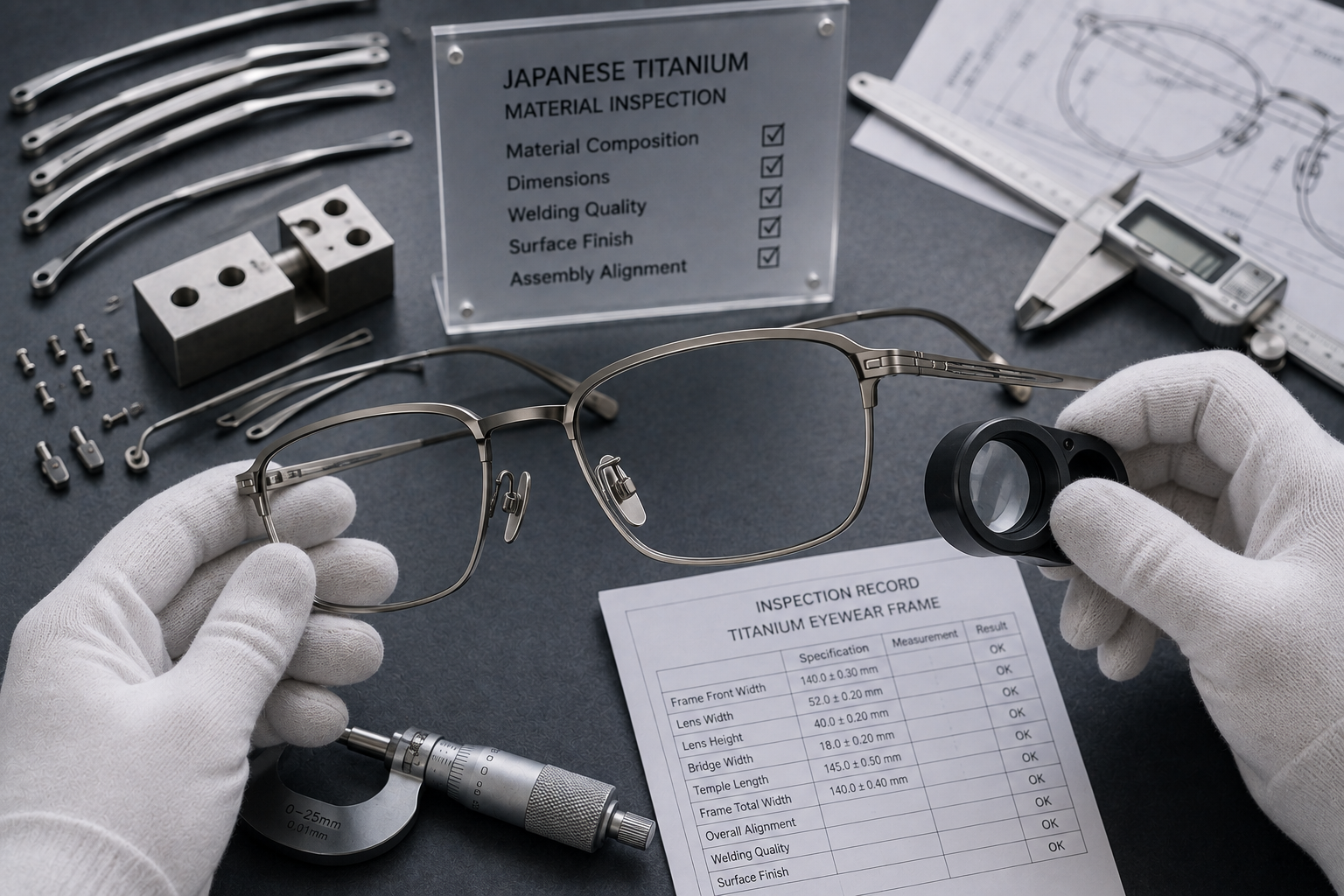
Material Verification and Finished Frame Inspection
Premium material positioning should be supported by consistent manufacturing quality. Material requirements and the finished frame should therefore be evaluated separately.
Finished-frame inspection can include dimensions, alignment, joining quality, hinge function and overall surface condition.
- Material specification review
- Frame-front dimensions
- Lens width and bridge dimensions
- Temple length
- Joining quality
- Frame alignment
- Surface finish inspection
Develop Japanese Titanium Eyewear Around Your Collection
Projects can begin from a drawing, reference frame, CAD direction or existing product concept.
Material specification, frame structure, finish, branding and sample feasibility can then be reviewed together before production.
- Custom optical frame development
- Custom titanium sunglasses
- Bridge and temple structure review
- Material specification review
- Sample development
- Logo and private label customization
Start with Your Project Brief
Send your drawing, reference frame, Japanese titanium requirement, target quantity, finish, logo and packaging direction.
Discuss Your Titanium ProjectMaterials, Manufacturing & OEM Development
Explore related pages to understand how Japanese titanium connects with material selection and manufacturing.
Japanese Titanium Eyewear FAQ
What is Japanese titanium eyewear?
The term generally refers to eyewear made with titanium material specified as Japanese-origin or sourced according to a defined Japanese material requirement. The exact supplier and specification should be confirmed.
Is Japanese titanium lighter than other titanium?
Frame weight depends on the material grade, wire or sheet dimensions, component design and overall frame geometry. Japanese origin alone does not determine final frame weight.
Can Japanese titanium be used for optical frames and sunglasses?
Suitable titanium specifications can be evaluated for both optical frames and sunglasses, subject to frame design and manufacturing feasibility.
Can we specify Japanese-origin titanium for our OEM project?
Yes. Specific material-origin requirements can be included in the project brief and reviewed before sampling.
Does Japanese titanium eyewear require welding?
Many titanium frame constructions use precision joining or welding, but the exact method depends on frame structure and component design.
What should we provide before sample development?
Send your drawing or reference frame, material-origin requirement, target quantity, frame finish, branding and packaging requirements.
Planning a Japanese Titanium Eyewear Collection?
Send us your frame design, reference product, material requirement, target quantity and finish direction. We can review the sourcing and manufacturing route before sample development.
Discuss Japanese Titanium Eyewear